

NFL betting once depended on familiar statistics. Passing yards, touchdowns, injuries and recent results gave bettors most of the information they used to judge a matchup.
NFL games now produce vast amounts of data. Player movement can be tracked live. Machine learning models can estimate completion probability, rushing expectations and win probability. More information is available to the bettors, but that doesn’t necessarily equate to better decisions. The difficulty is determining which statistics matter and if the information is already factored into the odds.
NFL Data Goes Beyond the Box Score
Modern tracking systems record player location, speed, distance, and acceleration. That gives analysts information a box score cannot provide.
A quarterback may complete two passes of 20 yards. The box score treats those plays similarly. The tracking stats can reveal that a certain pass was thrown to a wide receiver who had a few yards of separation while another pass was completed despite tight coverage and under pressure.
Instead of just wondering if a quarterback completed 65 percent of his passes, the bettor can find out how hard those passes were.
AI Turns Raw Numbers into Useful Information

“A young man multitasking with a smartphone and laptop.”
Data collection is just the beginning. More difficult is determining any useful patterns within the data.
Machine learning can sort through large datasets and identify useful relationships. The NFL models can predict the probability of completing a pass or expected rushing yards, as well as how a particular game situation changes the chances of winning.
A team winning 35 to 17 sounds impressive. The underlying numbers may show that the team benefited from short fields, turnovers or several low-probability completions.
For anyone interested in NFL Betting, this is where AI becomes useful. It can help test whether a strong result reflects repeatable performance or a combination of events that may not happen again.
Better Data Does Not Guarantee Better Bets
A typical mistake is thinking that just because a statistic is advanced, it has to be worth something.
Betting on NFL games is a very competitive market, where all kinds of information are at the disposal of sportsbooks.
If an apparent trend can be seen in the data, there is a good chance that such information is already priced in.
According to NFL Football Operations, Next Gen Stats uses technology to collect information about players’ game performance. It gives bettors much more data to work with, although the right interpretation is essential.
What really matters is not predicting every winner. Bettors have to evaluate if the implied probability of winning is different enough from their own evaluation to make betting profitable.
How Bettors Can Use AI and Data Better
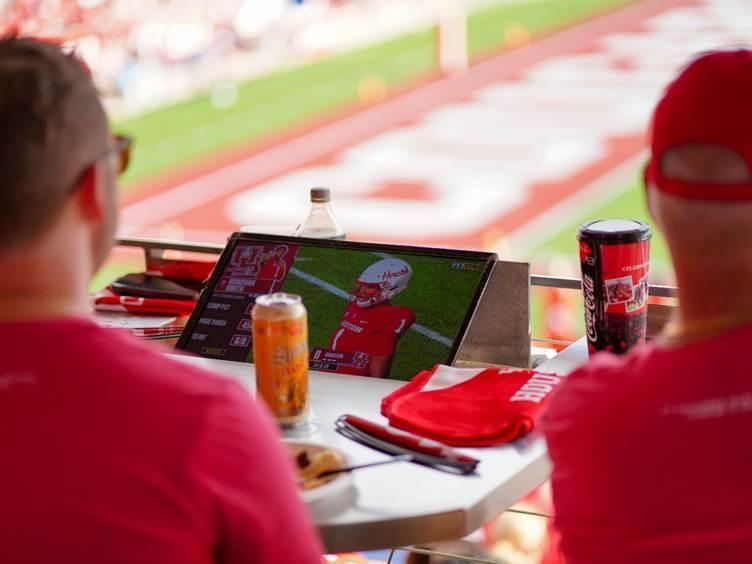
“Fans enjoying a live football game on a tablet at a stadium.”
You do not need specialist software or coding skills to use AI and data more effectively when assessing NFL bets.
An understanding of the distinction between value betting and guess betting will allow bettors to consider prices rather than just the team they believe will win.
Even if there is a 60 percent probability of winning, this means the team may still lose four times out of ten according to the model’s calculations.
AI Is Making Betting Markets More Competitive
The same technology is also used across professional sports analysis and the wider betting industry.
That can lead to faster market reactions when important information becomes available. Injury reports, lineup changes, and performance data can affect expectations quickly.
The scale of NFL betting explains why better analysis attracts so much attention. The American Gaming Association estimated that Americans would legally wager a record $1.76 billion on Super Bowl LX in 2026, showing how much money can move around a single NFL game.
AI is giving NFL bettors access to information that was difficult to obtain a few years ago. The advantage comes from knowing how to use it.
Think of advanced statistics as proof, compare probabilities to prices, and challenge findings that seem exceptionally favorable or unfavorable. Maintain a record rather than rely on memory, and establish a budget for wagering before the game starts.
The next time you analyze an NFL match, pay attention to something other than just the score. Examine the statistics behind the score, compare your probability to the price offered, and only place a wager if the math checks out.