
Table of Contents
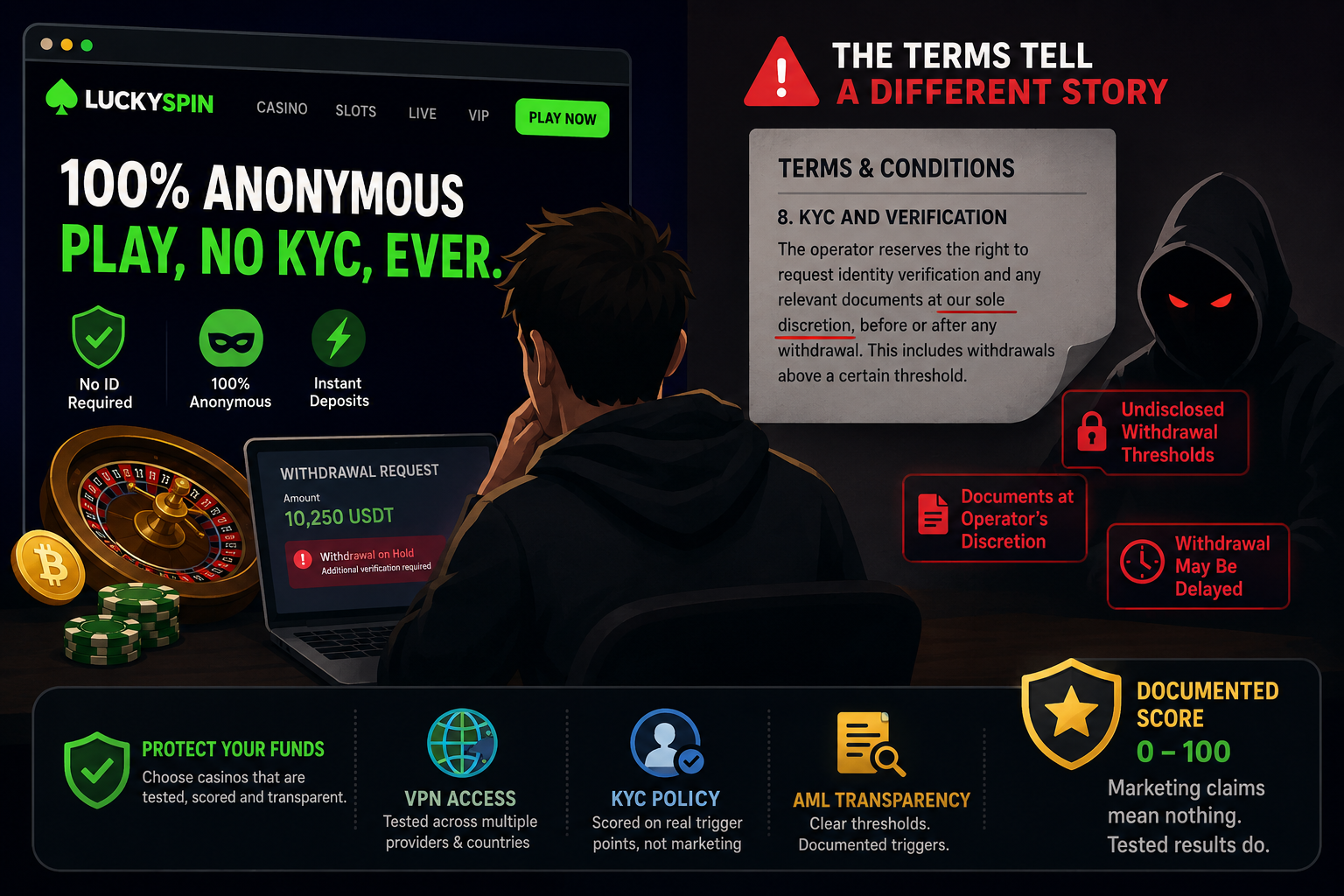
ToggleSomewhere in the crypto gambling world there's a casino homepage right now promising "100% anonymous play, no KYC, ever." Somewhere in that same casino's actual terms and conditions, buried three clicks deep, there's a clause reserving the right to request identity documents "at the operator's discretion" for any withdrawal above a threshold nobody advertises on the homepage. Both statements are technically true. Only one of them is honest.
This is the gap that defines crypto gambling right now, and it's bigger than most players realize until the day their own withdrawal gets stuck behind it.
Access Without Payout Isn't Access
A casino can let you connect from anywhere, register in thirty seconds, and deposit crypto instantly. None of that means anything if the same casino freezes your account the moment you try to leave with a win. That's the actual definition of VPN tolerated versus VPN friendly, and the difference matters enormously for anyone using a VPN specifically to reach a better operator than the one available in their own country.
VPN tolerated means the terms don't explicitly mention VPN use, and the site simply hasn't gotten around to blocking it yet, or blocks it selectively depending on how a player behaves. VPN friendly means the operator states outright that VPN access is allowed and that access has been confirmed stable across repeated testing, not a single lucky login from one location. A casino that quietly falls into the first category can flip on a player without warning the moment a big win shows up in the queue.
Ambush KYC Is the Uglier Cousin of the Same Problem
The parallel trap on the identity side is what gets called ambush KYC. A site markets itself loudly as no-KYC, plays that way for weeks or months of normal deposits and small withdrawals, then demands a passport photo and a utility bill the instant a cashout crosses some undisclosed line. The player only discovers the real policy after the money is already sitting inside the platform, and by then they're negotiating from a position of zero leverage.
Genuinely no-KYC operators do exist, and light-KYC operators that only trigger verification on very large withdrawals or clear fraud signals are a real, workable middle ground. The problem is telling the three categories apart from a homepage banner alone, because they all use nearly identical marketing language until the moment they don't.
A Documented Score Beats a Marketing Claim Every Time
This is exactly the gap VPN Casinos built its entire ranking system to close. Every operator gets scored zero to one hundred across three weighted pillars: VPN access policy and KYC policy at 40 percent each, with AML transparency making up the remaining 20 percent. VPN access gets tested across multiple providers and multiple exit countries, repeated over time rather than checked once, because a site that "works once" during a single login test doesn't tell anyone anything useful about how it behaves six months and one big win later.
KYC gets graded on the actual trigger point rather than the marketing copy sitting on the homepage. Truly no-ID operators score highest. Light KYC triggered only by very large withdrawals or clear red flags scores in the middle. Standard KYC at first withdrawal scores lower still. And ambush KYC, the operator that markets itself as no-KYC but demands ID the moment a real cashout request lands, is an automatic fail regardless of how the rest of the platform performs. AML transparency rewards operators that publish actual dollar thresholds and document triggers, and penalizes the vague "we may request documents at any time at our discretion" boilerplate that gives an operator total legal cover to freeze funds indefinitely without ever having to explain why.
Why This Matters More for Crypto Users Specifically Than Anyone Else
Crypto transactions are irreversible. There's no chargeback, no fraud department to call, no bank reversing a payment because a casino decided to sit on a withdrawal for three weeks under a vague "review" label. That single fact is exactly why the VPN access and KYC behavior of an operator matters so much more in crypto gambling than it does anywhere else in online finance. A frozen fiat withdrawal is an annoyance you can escalate through a bank or a card network. A frozen crypto withdrawal sitting inside a casino's custody is, functionally, gone until the operator feels like releasing it, and there is no third party on earth who can force their hand.
That's also the entire argument for testing access and payout behavior from multiple countries over multiple sessions instead of trusting a single glowing homepage claim. A star rating built from repeated testing across regions tells a player something real. A banner that says "100% anonymous" tells them nothing except that the marketing team knows exactly which words convert.